


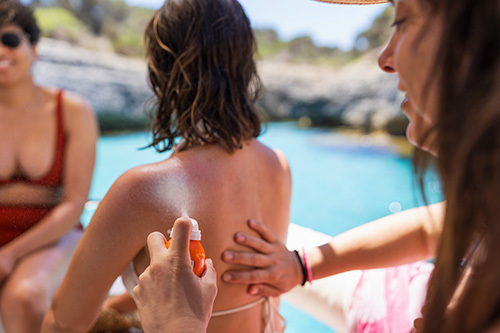
Memorial Day marks the start of summer fun outdoors, from cookouts to beach trips—often with less clothing and more sun. While enjoying the sun, it's necessary to stay safe and use sunscreen regularly.*
What Is the UV Index?
If you’ve ever checked the weather and seen a UV index number, you might have wondered what it means. So, what is the UV index? It’s a scale that tells you how strong the sun’s ultraviolet (UV) rays are on a given day. The higher the number, the greater your risk of skin damage.
Understanding the UV index and sunburn risk can help you plan your day:
- 0–2 (Low): Minimal risk. You may still want sunglasses. How long does it take to get sunburn? Usually 60 minutes or more.
- 3–5 (Moderate): Start protecting your skin. Use sunscreen, wear a hat, and seek shade. Sunburn can happen in about 30–45 minutes.
- 6–7 (High): Protection is essential. Limit time in the sun between 10 AM and 4 PM. You can burn in 15–25 minutes.
- 8–10 (Very High): Try to minimize sun exposure. Use strong protection. Sunburn can happen in under 15 minutes.
- 11+ (Extreme): Rare in our region, but dangerous. Skin can burn almost instantly—avoid direct sun when possible.
In Pennsylvania and nearby coastal areas such as New Jersey, Delaware, and Maryland, UV index levels typically peak between 6 and 10 during the summer.
How to Prevent Sunburn
If you’re wondering how to prevent sunburn, the answer starts with good sunscreen habits and smart planning.
Always use sunscreen with SPF 30 or higher. SPF (Sun Protection Factor) measures how well sunscreen protects your skin from UVB rays that cause sunburn. On days when you’ll be outside for long periods, like at the beach or a sporting event, consider SPF 50 or higher. If you have sensitive skin, look for sunscreens labeled as fragrance-free or hypoallergenic to help reduce the chance of irritation.
How much sunscreen should you use? Most people don’t apply enough. A good rule is about two tablespoons for your whole body, and a nickel-sized amount just for your face. For best results, apply sunscreen 15 to 30 minutes before going outside so your skin has time to absorb it and you’re fully protected as soon as your activities begin. If you’re using a spray, make sure your skin has an even, visible sheen before rubbing it in.
Reapplication is just as important. Sunscreen should be reapplied every two hours, and more often if you’re swimming or sweating heavily. For children, take extra care: dress them in protective clothing, such as wide-brimmed hats and long-sleeve shirts, and encourage play in the shade whenever possible. Kids' skin is especially sensitive to the sun, so be sure to cover often-missed spots like ears, the back of the neck, and the tops of feet.
What Sunscreen is Best?
You might be asking, " What sunscreen is best? The answer depends on your needs, but there are a few key things everyone should look for:
- Broad-spectrum protection: Meaning it protects against both UVA (aging) and UVB (burning) rays.
- Water resistance: Look for products labeled water-resistant for 40 or 80 minutes, especially if you’ll be swimming or sweating.
- SPF 30 or higher: This is the minimum recommended level for effective protection.
Whether you choose a lotion, spray, or stick, the best sunscreen is the one you’ll use regularly and apply correctly.
Stay Sun Safe
Spending time outdoors is one of the best parts of the Memorial Day weekend and the summer season. But without proper protection, it can also increase your risk of sunburn and long-term skin damage.
By understanding the UV index, knowing how long it takes to get sunburned, and using sunscreen with SPF 30 or higher, you can enjoy the sunshine safely. Simple steps now protect your skin for years to come.

*Medical Disclaimer
The information provided in this article is for general educational purposes only and is not intended as a substitute for professional medical advice, diagnosis, or treatment. Always seek the guidance of a qualified healthcare provider with any questions you may have regarding a medical condition. Dermatology Partners is not responsible for any errors, omissions, or outcomes resulting from reliance on this information.
Sources
WebMD. (2024, February 12). The UV index explained.
https://www.webmd.com/skin-problems-and-treatments/uv-index-overview
U.S. Environmental Protection Agency. (2026). Sun safety monthly average UV index (2006–2023).
https://www.epa.gov/sunsafety/sun-safety-monthly-average-uv-index-2006-2023#tab-5
American Academy of Dermatology. (n.d.). How to select sunscreen.
https://www.aad.org/public/everyday-care/sun-protection/shade-clothing-sunscreen/how-to-select-sunscreen
Skin Cancer Foundation. (n.d.). Ask the expert: How much sunscreen should I be using on my face and body?
https://www.skincancer.org/blog/ask-the-expert-how-much-sunscreen-should-i-be-using-on-my-face-and-body/


