


Skin cancer awareness is essential for everyone—but it becomes especially critical for individuals with a personal or family history of skin cancer. Early detection can greatly enhance results, particularly when it comes to melanoma, the most aggressive form of skin cancer.
One of the most widely recognized tools for early detection is the ABCDEs of skin cancer, a simple yet effective method you can use during a self-check at home.*
What Are the ABCDEs of Skin Cancer?
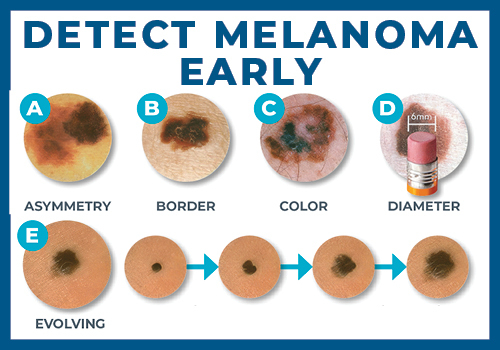
The ABCDEs present a structured way to evaluate moles and skin lesions for warning signs that may indicate melanoma or other forms of skin cancer. Here’s a closer look at each component:
A – Asymmetry
Benign moles are typically symmetrical, meaning one half resembles the other. If you draw an imaginary line through a mole and the two halves do not match, this asymmetry can be an early warning sign of melanoma. Irregular shape is often one of the first indicators that something may be abnormal.
B – Border
Healthy moles usually have smooth, even borders. Pay attention to edges that appear irregular, scalloped, or poorly defined. An irregular or blurred border can suggest that the lesion is growing unpredictably, which warrants further evaluation during a skin cancer screening.
C – Color
Uniform color is typical of benign moles, usually appearing as a single shade of brown. A mole that contains multiple colors—such as varying shades of brown, black, tan, red, white, or even blue—can be concerning. Uneven pigmentation is a hallmark feature often associated with melanoma.
D – Diameter
While skin cancers can be smaller, a general guideline is to monitor moles larger than 6 millimeters (about the size of a pencil eraser). Larger lesions are more likely to be problematic, especially if they continue to grow over time. However, it’s important to note that melanoma can still occur in smaller spots, so size should not be the only factor considered.
E – Evolving
Perhaps the most critical factor is change. Any mole that evolves in size, shape, color, or elevation—or begins to itch, bleed, or crust—should be evaluated by a professional. Evolution is often the clearest indicator that a lesion may be malignant.
Why Are the ABCDEs Important?
The ABCDEs of skin cancer serve as a practical, easy-to-remember framework for identifying suspicious lesions during a self-check. They strengthen individuals to take an active role in their own skin health by recognizing early warning signs before they progress.
While this method is not a substitute for a professional skin cancer screening, it acts as a valuable first line of defense. Many cases of melanoma are first noticed by patients themselves, making routine self-checks a critical component of early detection.
By increasing skin cancer awareness and supplying a standardized approach, the ABCDEs help bridge the gap between noticing a change and seeking medical attention. They are especially useful for individuals at higher risk, including those with fair skin, a history of sunburns, excessive UV exposure, or a family history of skin cancer.
A Brief History of the ABCDE Method
The ABCDE method was first introduced in 1985 by a group of physicians at New York University. Initially developed as the “ABCD” criteria, the model was designed to help clinicians identify early signs of melanoma during examinations. Over time, the “E” for evolving was added to emphasize the importance of change in detecting malignancies.
Since its introduction, the ABCDE framework has been validated by numerous studies and widely adopted in both clinical settings and public health education. Decades later, it remains one of the most trusted tools for promoting early detection and boosting patient outcomes.
Incorporating the ABCDEs Into Your Routine
Performing a monthly self-check is a simple yet effective way to keep proactive about your skin health. This can be done by using a full-length mirror and a hand mirror to examine all areas of your body, including hard-to-see spots such as your back, scalp, and soles of your feet.
Keep track of existing moles and note any changes over time. Taking photos can be particularly helpful for monitoring evolution. If you identify any spots that meet one or more of the ABCDE criteria, it’s important to schedule a professional skin cancer screening with a dermatologist.
When to Seek Professional Care
While the ABCDEs are a powerful educational tool, they are not diagnostic. If you begin to notice any suspicious moles or changes in your skin, do not wait. Early evaluation is key—especially for melanoma, where early-stage detection dramatically improves survival rates.
Regular skin cancer screenings by a qualified provider should complement your at-home self-checks, particularly if you fall into a higher-risk category.
Perform a Self Check & Seek Treatment
The ABCDEs of skin cancer offer a clear, accessible way to monitor your skin and detect potential warning signs early. By incorporating this method into your routine and staying vigilant, you play an active role in protecting your health.
If you notice any concerning changes, use the ABCDE guidelines as a reference and seek professional evaluation promptly. For expert care and comprehensive skin cancer screening, schedule an appointment at a Dermatology Partners location near you. Early detection can make all the difference.
*Medical Disclaimer
The information provided in this article is for general educational purposes only and is not intended as a substitute for professional medical advice, diagnosis, or treatment. Always seek the guidance of a qualified healthcare provider with any questions you may have regarding a medical condition. Dermatology Partners is not responsible for any errors, omissions, or outcomes resulting from reliance on this information.
Source
National Cancer Institute. (n.d.). Moles to melanoma: Recognizing the ABCDE features. U.S. Department of Health and Human Services. Retrieved April 2, 2026, from https://moles-melanoma-tool.cancer.gov/
American Academy of Dermatology Association. (n.d.). What to look for: ABCDEs of melanoma. Retrieved April 2, 2026, from https://www.aad.org/public/diseases/skin-cancer/find/at-risk/abcdes
Cleveland Clinic. (2025, August 26). Skin self-exam: ABCDEs of skin cancer. Retrieved April 2, 2026, from https://my.clevelandclinic.org/health/diagnostics/8648-skin-self-exam
American Cancer Society. (n.d.). Early detection of melanoma: Reviewing the ABCDEs. CA: A Cancer Journal for Clinicians. Retrieved April 2, 2026, from https://acsjournals.onlinelibrary.wiley.com/doi/full/10.3322/caac.20074


